
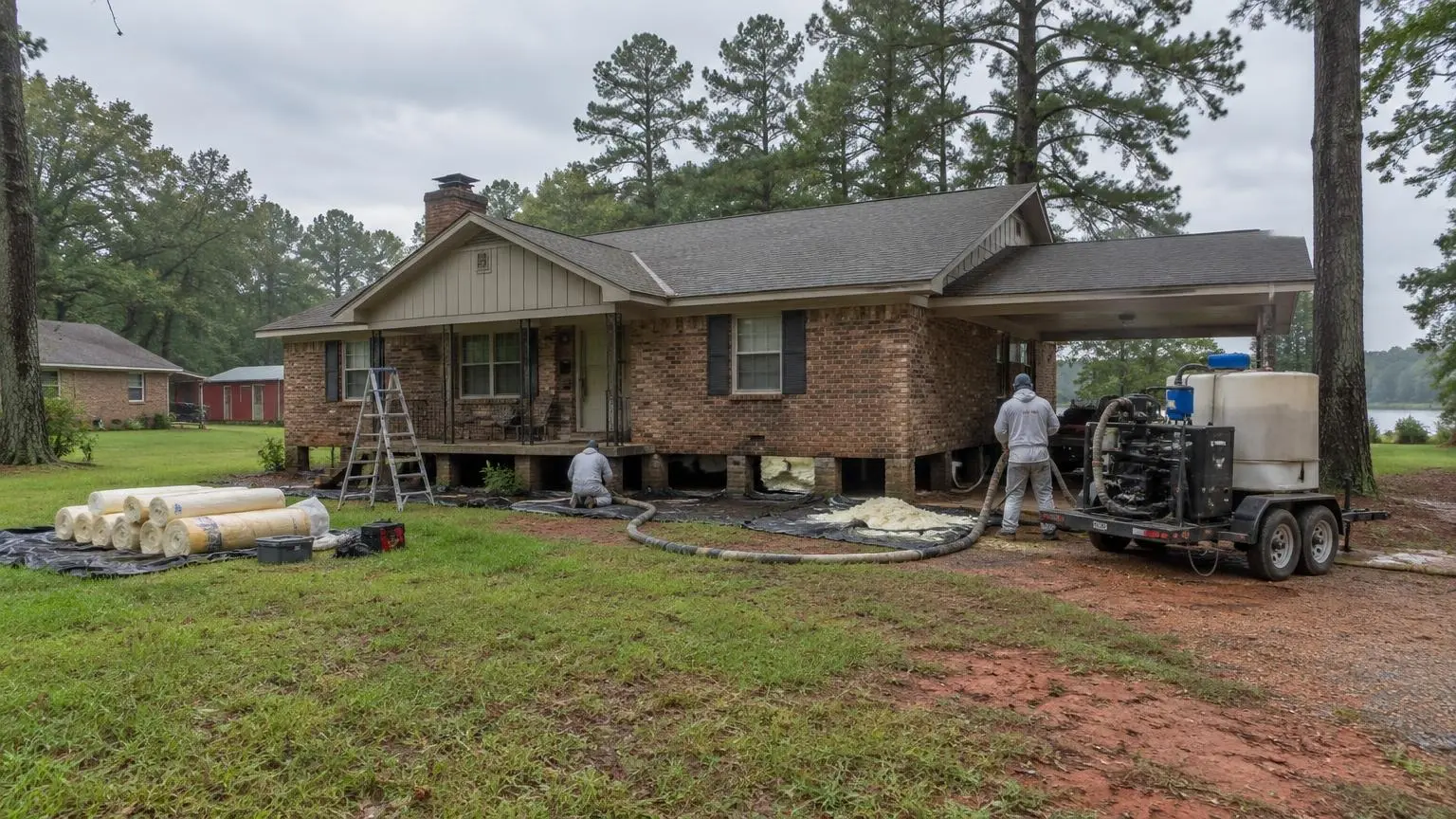
Both sides of the state line
Spray Foam Insulation in Texarkana, TX
Seal out summer heat and humidity, dry out the crawl space, and keep the shop from sweating, with written plans and clear prices.
- Free estimates after an in-person look
- Written quotes that list foam type, thickness and R-value
- Moisture, ducts and old insulation checked before anything is covered
Heat, Humidity and 50 Inches of Rain
Spray foam insulation in Texarkana has two jobs: keeping heat out and keeping moisture under control. The 1991-2020 normals for Texarkana, Texas, show a July average high of 93.3F and about 52 inches of precipitation a year, and the Arkansas side's Webb Field station records nearly 49 inches. Summers are humid, the ground stays damp, and many local homes sit over crawl spaces where that dampness meets the floor. We seal and insulate attics, crawl spaces, walls, shops and pole barns on both sides of State Line Avenue, using open-cell or closed-cell spray foam where it is the right tool and blown-in insulation where it does the job for less.
Two states, two codes
OpenEI places Bowie and Cass counties in Texas and Miller and Little River counties in Arkansas all in Climate Zone 3A, the warm and humid band. The codes differ by state. Texas still uses the energy chapter of the 2015 International Residential Code statewide, which in Zone 3 lists R-38 for ceilings, R-20 or R-13 plus R-5 continuous for wood-frame walls, and R-19 for floors. Arkansas uses the 2009 IECC with state amendments, in effect since January 1, 2015, which lists R-30 for ceilings and R-13 for walls in Zone 3. For existing homes on either side, ENERGY STAR suggests R-49 for a bare attic, adding R-38 where three to four inches are already there, and R-19 under floors.
Crawl spaces and humidity
In a crawl space home, damp air under the house rises into the floor and the living space. Batts stapled under the floor tend to sag and fall as they soak up moisture, and ducts running through the crawl space sweat in summer. We either insulate the floor properly with closed-cell foam that does not take on water, or seal the crawl space, insulate its walls and lay a vapor barrier so the space stays drier. Which is better depends on the house, the ductwork and how wet the ground is.
Where Texarkana houses lose the most
The Texas side had 16,270 housing units in the 2020 census and the Arkansas side 13,593. The twin cities have homes from the 1870s onward: old frame houses near downtown, wartime and postwar homes built for Red River Army Depot and Lone Star Army Ammunition Plant workers, and newer subdivisions. Older homes often have little attic insulation and open framing; postwar homes often have crawl spaces with failing batts; newer homes still have gaps at attic hatches, bonus rooms and garage ceilings.
Closed cell vs open cell
Open-cell foam is soft and expands a lot. It seals air well, quiets sound and costs less per inch, and HomeGuide lists it at R-3.5 to R-3.7 per inch. It is common under roof decks when the attic is being sealed. Closed-cell foam is dense and rigid at R-5 to R-7 per inch; it slows vapor and does not soak up water. In this humid area, that makes it our usual choice for crawl spaces, rim joists, the underside of floors and metal buildings. The quote names the foam for each area.
Spray foam or blown-in in the attic
For an open attic with ducts in fair shape, sealing the ceiling and blowing in cellulose or fiberglass to R-38 or R-49 is usually the most cost-effective path. When the air handler and ducts sit in the attic, foaming the roof deck brings them into the conditioned space. We price both when both fit and say which we would choose.
Spray foam insulation cost
HomeGuide's 2026 guide lists installed spray foam at $1.50 to $5.00 per square foot, open-cell at $1.50 to $3.50 and closed-cell at $3.00 to $5.00. It puts crawl space spray foam at $2,000 to $4,000 and an attic at $3,000 to $8,000, and notes that many installers charge a minimum of $1,000 to $2,000 or more. Its crawl space encapsulation guide lists $3,000 to $15,000. Blown-in runs $1.00 to $2.80 per square foot. These national ranges help with budgeting; your space, the method and any removal set the real number, and the written estimate is what you pay.
Questions to ask insulation contractors
When you talk to spray foam insulation contractors or insulation companies in Texarkana, ask each one the same things. What will you seal first? Which foam goes where, how thick, and what R-value does that give? How will you handle moisture in the crawl space? If the roof deck is being foamed, how are attic vents closed? Does exposed foam need a thermal or ignition barrier? How long do we stay out while it cures (HomeGuide says at least 24 hours)? Which code applies on our side of the line? A one-number bid is hard to compare; ours lists every area.
SWEPCO weatherization help
SWEPCO's weatherization page says the utility helps pay for insulation and caulking and weatherstripping through approved contractors in Arkansas, Louisiana and Texas, and that income-qualified households may get those measures at no cost. If SWEPCO is your utility, check its current program and contractor list before your job.
Texas and Arkansas Towns We Cover
We work in Texarkana, Texas and Texarkana, Arkansas, and the towns around them: Nash, Wake Village, Hooks, New Boston, Redwater, Maud and De Kalb in Bowie County; Atlanta and Queen City in Cass County; Genoa and Fouke in Miller County, Arkansas; and Ashdown and Foreman in Little River County. Wartime housing near the depot, older county-seat homes, timber and farm country, and newer suburbs each bring something different, and the town pages explain what.
- Spray Foam Insulation in Texarkana, TX
- Spray Foam Insulation in Texarkana, AR
- Spray Foam Insulation in Nash, TX
- Spray Foam Insulation in Wake Village, TX
- Spray Foam Insulation in Hooks, TX
- Spray Foam Insulation in New Boston, TX
- Spray Foam Insulation in Redwater, TX
- Spray Foam Insulation in Maud, TX
- Spray Foam Insulation in De Kalb, TX
- Spray Foam Insulation in Atlanta, TX
- Spray Foam Insulation in Queen City, TX
- Spray Foam Insulation in Genoa, AR
- Spray Foam Insulation in Fouke, AR
- Spray Foam Insulation in Ashdown, AR
- Spray Foam Insulation in Foreman, AR
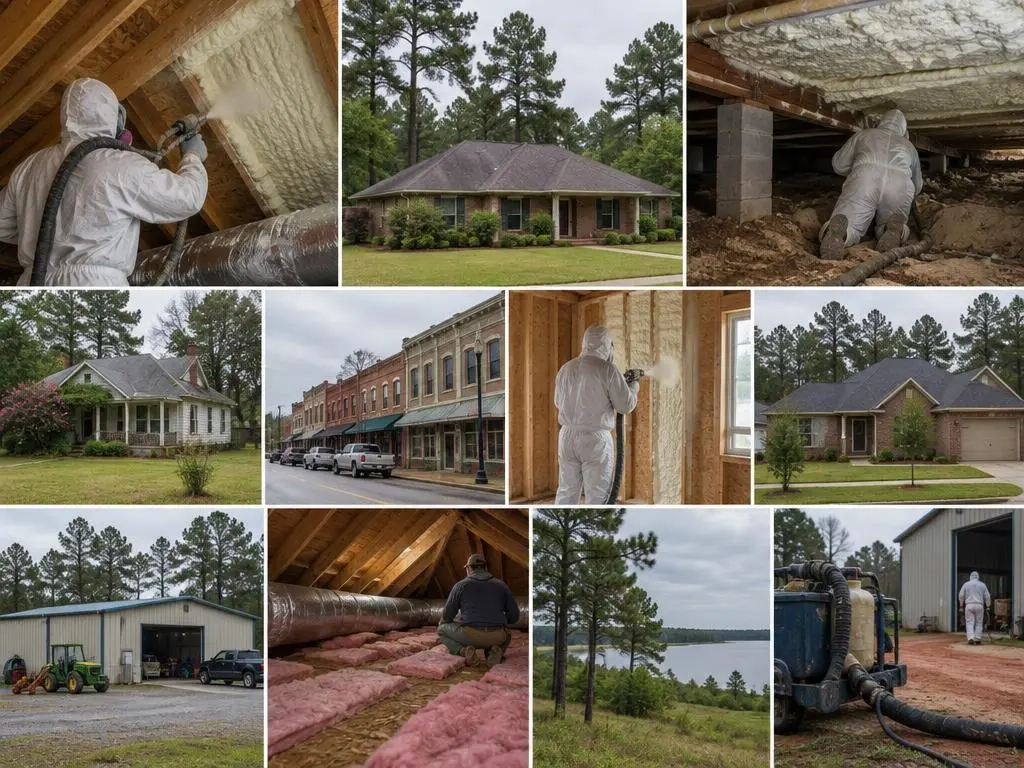
Common Questions
Is spray foam a good idea in a humid climate like Texarkana?
Closed-cell foam is well suited to damp places like crawl spaces and rim joists because it does not take on water. Open-cell works under roof decks. The key is fixing leaks first and choosing the foam for the space.
Should I insulate my crawl space floor or encapsulate it?
It depends on the ductwork, the ground moisture and your budget. Insulating the floor costs less; sealing the crawl space keeps ducts and pipes in a drier, more stable space. We price both.
What R-value does a Texarkana attic need?
On the Texas side, the 2015 code lists R-38 for new ceilings; on the Arkansas side, the 2009-based code lists R-30. ENERGY STAR suggests R-49 for a bare existing attic in Zone 3.
How much does spray foam insulation cost?
HomeGuide's national figures put it at $1.50 to $5.00 per square foot installed. Crawl spaces run $2,000 to $4,000 and attics $3,000 to $8,000. Your written estimate is the price.
Does SWEPCO help pay for insulation?
SWEPCO's weatherization page lists insulation and caulking and weatherstripping through approved contractors in Arkansas, Louisiana and Texas. Check its current program before your job.
Can you insulate a shop or pole barn?
Yes. Closed-cell foam on the steel cuts heat and stops condensation drip.
Why Homeowners Call Spray Foam Insulation Texarkana
Moisture comes first
Leaks and wet crawl spaces get fixed before insulation covers them.
We know both codes
Texas and Arkansas targets differ, and the quote uses the right one.
Foam where it fits
Blown-in or batts where they do the job for less.
Quotes you can compare
Material, thickness, R-value and price for each area.
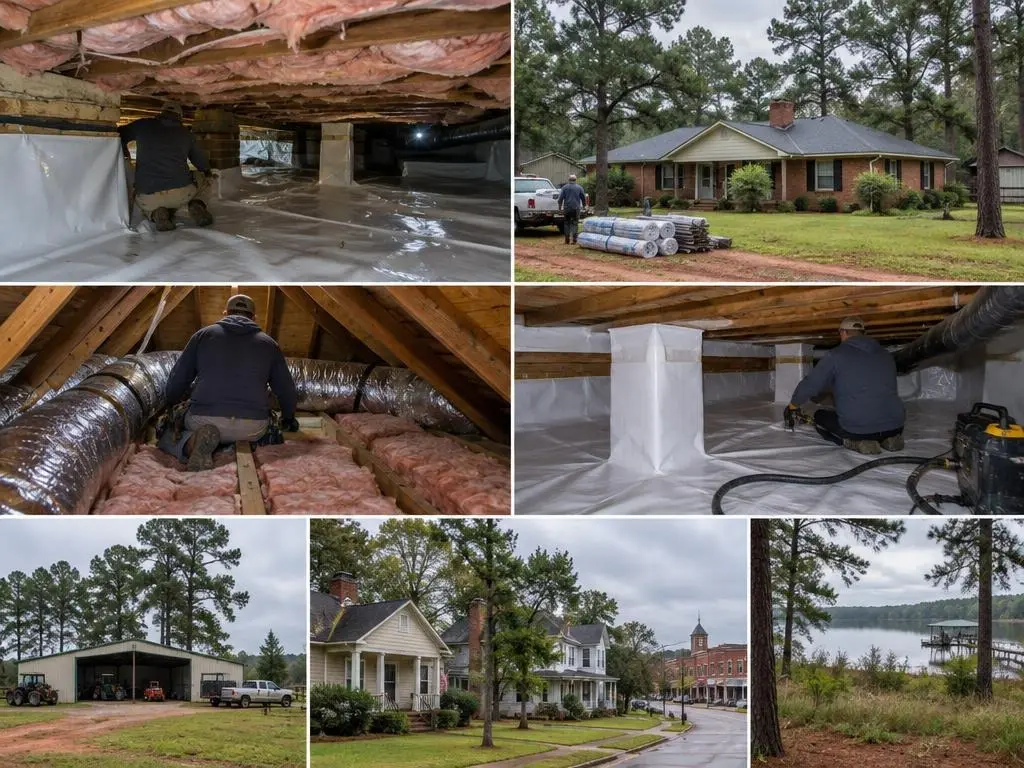
Our Services
Six services for homes and buildings in the Ark-La-Tex, from closed-cell foam in the crawl space to a full attic cleanout.
Spray Foam Insulation
Open-cell and closed-cell foam that insulates and air seals in one layer, for attics, crawl spaces, walls and steel buildings.
Learn more →Crawl Space Insulation & Encapsulation
Insulating floors over crawl spaces, or sealing the crawl space with a vapor barrier and insulated walls.
Learn more →Attic Sealing & Insulation
Sealing the gaps between the house and attic, then adding insulation to the depth your side of the line calls for.
Learn more →Pole Barn & Shop Insulation
Closed-cell foam for pole barns, steel shops, garages and equipment buildings in timber and farm country.
Learn more →Blown-In Cellulose & Fiberglass
Loose-fill insulation blown over a sealed attic floor or dense-packed into closed walls.
Learn more →Attic Insulation Removal
Vacuuming out wet, moldy, rodent-soiled or worn-out attic insulation so the attic can be sealed and re-insulated.
Learn more →Get a Written Estimate
We look at the attic, crawl space or building, then send a written price with the material and R-value for each area.